
Raleigh County Deed Records and Their Uses
The Raleigh County Clerk records every instrument that transfers or affects an interest in land. Not everything in the land index is a deed in the strict sense. A deed conveys an interest. A deed of trust secures a debt. A release clears a recorded claim. A plat maps lots. Each does a different job. The table sorts these roles apart. So a property search starts with the record type that actually answers the question at hand.
| Deed Type | What It Does | Common Use |
|---|---|---|
| Deed | Records a conveyance or transfer of a land interest. | Sale, family transfer, fiduciary transfer, or other conveyance. |
| Deed of trust | Records a security interest associated with debt. | Loan or financing record; look for later release. |
| Release or satisfaction | Records the release of an earlier recorded claim. | Match it to the deed of trust or lien reference. |
| Trustee report of sale | Documents a reported foreclosure sale step. | Check authority, case, redemption, and later deed. |
| Plat, assignment, or easement | Maps lots or records a related land right. | Compare with the deed’s legal description. |
One parcel can carry both a deed and a lien doing separate work. The Clerk's index categories also cover deeds of trust and judgments. State and federal liens, assignments, agreements, affidavits, rights of way, cemetery deeds, and plats appear there too. A release only matters when tied to the filing it resolves. The category label alone can't tell you this. It can't say whether a later instrument changed the status of the original deed.
The Raleigh County Land Record Directory
The public Raleigh land-record directory organizes deed and non-deed categories side by side: deeds of trust, liens, releases, cemetery deeds, plat maps, assignments, affidavits, and trustee reports of sale. The Clerk's own page lays out in-person, email, and mail routes for copies. The directory itself is a category list. It is not a search form, so don't assume specific grantor, grantee, date, or image fields from it. Use it to name the likely instrument type first. Then check whether a search or image covers the date you need.
If an older entry isn't online, the Record Room can help. Staff can search party names, an approximate year, the parcel number, and the legal description in the local index or book. That request often reaches records the web index never shows.
The directory screen displays Raleigh's public land-record categories. Open the Raleigh County Land Records directory to see the available record types. Expect a directory view, not a deed image or a search result.
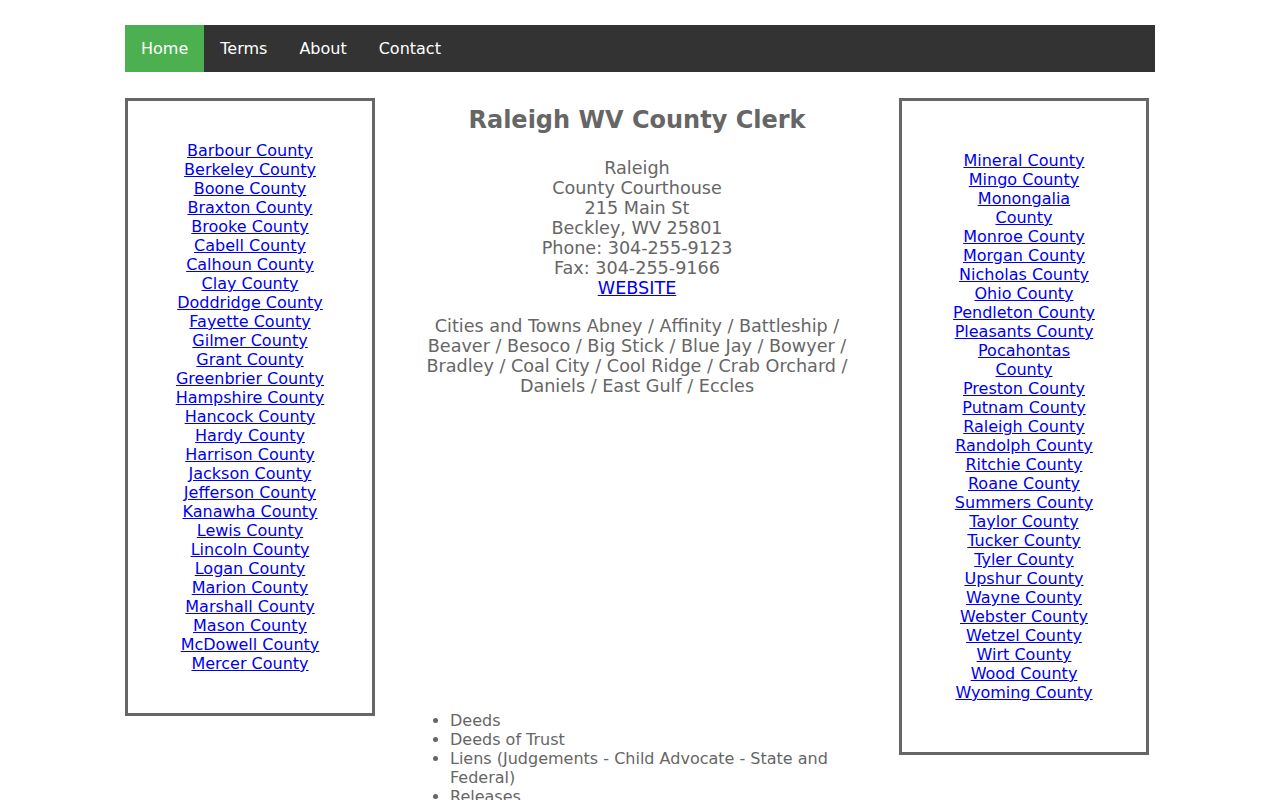
Categories point you to the right record family. They say nothing about the current status of a particular deed of trust or lien.
Raleigh County Grantor and Grantee Searches
A grantor conveys the interest and a grantee receives it. Simple enough. In a chain search, locate the current instrument and read its grantee and prior deed reference. Then search that grantee as the next link going back in time. The Clerk's materials confirm deed recording back to the county's formation. The online index cutoff isn't stated anywhere, so treat a gap online as a search gap rather than proof the deed never existed.
Names shift along a chain. Search the exact trust or company name, prior surnames, initials, and estate or fiduciary names where the deed allows it. At every step, compare the parcel or map key and the lot or subdivision reference. Then check the legal description. A familiar name alone can lead to the wrong parcel of land.
- Locate the newest recorded deed using the current owner, parcel, legal description, or a known instrument reference.
- Record its grantor, grantee, recording date, deed book/page or document reference, and the land description.
- Search the grantee as a later grantor and locate the prior deed that brought the interest to that party.
- Repeat with each prior grantee, checking name variants, parcel changes, and fiduciary transfers.
- If the online index ends, ask the Record Room about deed books, microfilm, or archival references.
- Grantor
- The person or entity named as conveying an interest.
- Grantee
- The person or entity receiving the interest in the instrument.
- Chain of title
- The ordered record of transfers affecting the described land.
- Book and page
- A local reference to a recorded document; use it as a lookup clue.
Raleigh Deed Books Reach Back to 1850
The County Clerk states that deeds have been recorded since Raleigh County formed in 1850. That establishes the local record run and its reach. It doesn't prove the full run is digitized. It doesn't prove the index starts at 1850. It doesn't prove every image is online. The exact online cutoff still needs direct confirmation. So treat a missing result as a search gap, not a missing deed.
For an older transfer, give the Clerk a name variant, the document type, an approximate year, and a legal description or parcel key. Ask whether a physical book, microfilm, or copy can be checked. Also ask whether a page, certification, plat, or postage charge applies. The state Archives and History Library is a separate fallback for county court, census, military, naturalization, newspaper, and older vital material. It's not a replacement for the Clerk's land index.
Note: Raleigh's verified 1850 start date covers the county record run, while the online index depth still requires direct confirmation.
Raleigh County Deed Copy Routes
The Clerk's Record Room handles requests three ways. You can visit in person, email recordroom@raleighcounty.gov, or mail a letter. Include everything you know. List the grantor and grantee, document type, recording date or year, book and page, parcel or map reference, and the property description. Payment options are check or money order by mail, cash in person, and credit card. Call before mailing to confirm the amount and current process.
The published copy schedule charges by the page. Certification and postage cost extra beyond a plain copy. A large plat carries its own fee. Recording fees apply only when you submit a new instrument for recording. They are not the same as a copy fee.
| Plain copy | $1.50 for the first two pages; $1 for each added page. |
|---|---|
| Certification | $1 per document, in addition to the copy. |
| Large plat or map | $10 black and white or $15 color, listed schedule. |
| Postage | Listed by page count; confirm the total before mailing. |
These figures come from the published fee schedule, so confirm current charges with the office before relying on them. A copy of a document never includes a title opinion.
Liens, Releases, and Deeds of Trust
The Raleigh County Clerk's record room handles far more than deeds. Deeds of trust, judgments and other liens, assignments, releases, rights of way, affidavits, and plats get recorded there. Trustee reports of sale do as well. For a mortgage or deed of trust, pull the original instrument first. Then hunt for its assignment and any release or satisfaction. Every release should cite the debt it clears. Judgment dockets and land-record liens can be related. They remain separate index entries, though.
Staff can help you locate records for a specific search. They cannot certify that land is free of liens or indebtedness. A real title review reconciles every open claim, later release, easement, covenant, and legal description. The Clerk publishes no property-fraud alert signup. Ask the office whether any recording-notification service exists rather than assuming one is available.
Getting a Copy of a Raleigh County Deed
Take the online deed directory only as far as its indexed years reach. Its available images also mark the limit. Beyond that, the Record Room can find an instrument by parties, date range, book and page, parcel, or legal description. Say what you need. An uncertified image, a certified copy, and a large plat are different requests. The Clerk can quote the right total for each. Certified vital records remain separate from land-record copies.
Recorded, not guaranteed. The Raleigh County index shows documents recorded in the public system. The Clerk does not certify clear title, and a partial index search may miss an interest or later release.
Foreclosure Reports and Court Files
Foreclosure paper trails run through two systems. The land-record directory holds trustee reports of sale and foreclosure instruments, while court files add complaints, judgments, lis pendens, and case orders. WVPASS launched statewide in 2025. Public circuit documents date to 1999. Registration for public search is free, but public downloads carry a per-page charge under the launch release. Confirm the field labels in the live system.
Magistrate Case Record Search is free and takes a name or case number. It caps results at 30 records. Request documents from the Clerk of the filing court. Expect docket information only, since the full file sits with the court. A docket notice never transfers the parcel, so look for the later recorded deed or trustee instrument.
Federal cases go through PACER and the Southern District of West Virginia. Visit the Southern District of West Virginia source for current federal court information, including the Beckley courthouse access route.
Federal courts are the wrong door for county matters. Land transfers and liens in Raleigh County stay in the Clerk's land-record system.
Plats and Older Raleigh Land Descriptions
Plat maps and cemetery deeds have their own categories in the Clerk's indexes. The Assessor's Beckley District 01 Map 75 sample labels roads and rights of way, original lot lines, deed lot numbers, parcel and index numbers, map boundaries, and revisions from 1999 through 2015. The PDF also carries a tax-purpose restriction. It helps a researcher find a lot reference. It is not the recorded subdivision plat or a boundary survey, though.
Historic deeds read differently. They may rely on lot and block, adjoining owners, roads, streams, or earlier tract descriptions. None of it may match a modern street number. Keep the full description. Compare it against the plat and the preceding deed. A split or changed tax parcel can leave the current map key out of sync with the older instrument. For a backward chain, the dedicated Raleigh County former owners page focuses on tracing earlier grantees.